
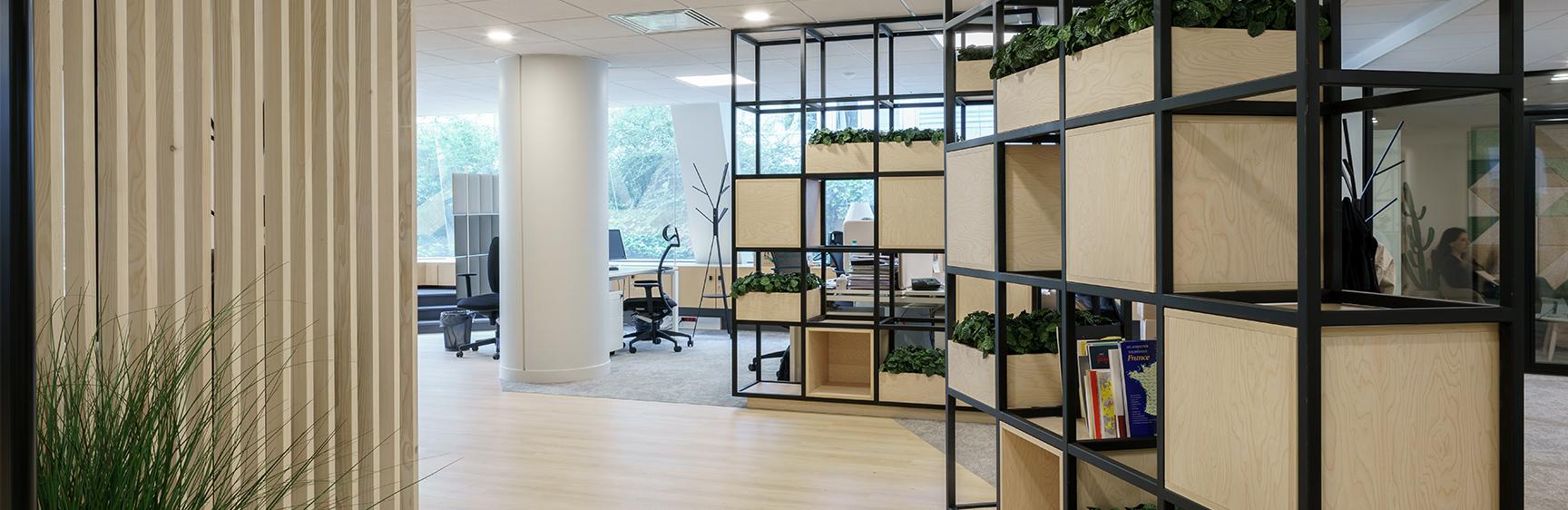
Have you recently acquired new premises for professional use? Then there's the tedious question of office fit-out standards, which can be a real headache for many employers. Particularly as the rules can differ according to the nature of the company's activity and the number of employees. These rules are important, however, insofar as they fulfil two objectives: on the one hand, to ensure the safety of people inside the premises, and on the other, to promote the well-being of workers. So, how big does a workspace need to be? What equipment is required in an ERT? Let us guide you, and we'll tell you what you need to know to get off to a good start.
Workspace size: what are the minimum surface requirements?
There is no minimum surface area for installing an office, as there is no legal requirement to do so. However, if you are concerned about providing your employees with a healthy and comfortable working environment, you can refer to the AFNOR NF X 35-102 standard, which sets out the following recommendations:
- for individual offices (in an enclosed room), the minimum surface area per person is 10m2;
- if the office is shared by several employees, the workspace size is 11m2;
- in the case of open-spaces or coworking spaces, which are often subject to noise, you'll need to allow for 15m2 per person.
Similarly, it's customary to avoidsetting up offices in elongated rooms, which are considered uncomfortable and not conducive to concentration. Rectangular or square rooms are preferable, as they are easier to adapt to your needs. Standard NF X 35-102 recommends thatworkstations be installed in rooms whose length is less than twice their width (if their surface area is less than 25m2) or three times their width for larger rooms. As for corridors, the standard sets a minimum width of 80 cm for the passage of one person, and 150 cm for two.
There are also standards for the size of worktops, this time specified by the Institut National de Recherche et de Sécurité (INRS). To guarantee good ergonomics, each employee should ideally have a desk 120 cm long, 80 cm wide and 72 cm high.
Enfin, des normes d’aménagement ont également été définies pour l’accessibilité des personnes à mobilité réduite. Aussi, si votre entreprise compte entre 20 et 200 salariés, vous devrez agencer un niveau pour faciliter la circulation des personnes présentant un handicap. En revanche, si votre entreprise dépasse 200 salariés, l’intégralité des niveaux devra leur être accessible. Pour vous assurer de respecter l’ensemble de ces exigences, faire appel à un architecte aménagement bureau est une garantie de conformité dès la phase de conception.
Fire and safety standards for office layouts
Contrary to the previous point, the law is quite precise on the subject of fire safety rules, and does indeed lay down layout standards for offices and ERT (Établissement Recevant des Travailleurs). According to article R. 4211-2 of the French Labor Code, your premises must include the following elements:
- An evacuation plan for the building, and a rallying point. To make sure your employees are familiar with evacuation procedures, it's a good idea to organize regular drills.
- A fire extinguisher on each floor.
- An emergency exit for 20 people, clearly visible and unobstructed. This must be at least 90 cm wide.
- A mechanical or natural smoke extraction system for any premises of 300m2 or more, and any blind room over 120m2.
- A working alarm system. And don't forget to highlight the various safety instructions.
All these installations designed to guarantee personal safety in ERTs must be inspected every 6 months. Finally, although it may seem obvious, the law stipulates that circulation corridors must remain clear and not have been used to store furniture.
The importance of lighting inside offices
If you work indoors, you've probably already noticed the extent to which light influences our mood and our motivation to undertake certain actions. Indeed, it has been recognized that the quality of lighting plays a significant role not only in well-being at work, but also in worker safety. So when you're considering office design standards, you'll also need to pay attention tolighting installation.
On this point, Article R. 4223-3 of the French Labor Code stipulates that: "workplaces must, as far as possible, have sufficient natural light". In other words, daylight should be used as much as possible, with artificial lighting used only as a supplement. To find out what is expected in terms of "sufficient brightness", we use the "lux" unit of measurement to define illuminance. The minimum number of lux required, however, differs according to the space and its use. It is therefore set at :
- 120 lux for work areas, washrooms and changing rooms;
- 40 lux for corridors ;
- 60 lux in stairwells and warehouses.
As 120 lux is considered the strict minimum for working properly, the NF 35-103 standard supplements the law by giving more precise references depending on the type of task. For example, in the case of a person working on a computer, processing data or writing reports, 500 lux is recommended. For complex tasks, such as laboratory work, the standard is 800 lux.
Lastly, article R. 4227-14 of the French Labor Code stipulates that emergency lighting must take over in the event of failure of the main system, to enable employees to evacuate the building.
The provision and location of sanitary facilities
Are you wondering if there are any office design standards for sanitary facilities? The answer is yes. These are set out in article R. 232-2-1, which stipulates that each company must "provide workers with the means to ensure their individual cleanliness".
In addition, this standard requires theinstallation of single-sex washrooms. Their location is also important, as toilets cannot be located directly adjacent to work areas. In terms of equipment, each washroom must include :
- one washbasin for every 10 people in the company;
- functional toilet flushes ;
- toilet paper ;
- an interior locking system ;
- and a system that can be opened from the outside in the event of a problem.
Men's toilets must include at least one urinal and one closed lavatory for every 20 men. For women's toilets, there must be a minimum of 2 closed cubicles for every 20 women, not forgetting a receptacle for menstrual protection.
A space dedicated to staff catering
There are also office fit-out standards on the question of catering rooms. However, companies with more than 25 employees are only obliged to install a space dedicated to meals. According to the law, this space must enable employees to eat in sufficiently hygienic and safe conditions, and must include the following equipment:
- tables and chairs;
- an appliance for reheating meals, such as a microwave;
- a refrigerator for food storage.
Even if these standards do not theoretically apply to companies with fewer than 25 employees, it is still the employer's responsibility to provide a small area where employees can eat on site.
Vous connaissez à présent les principales normes d’aménagement de bureaux ainsi que les équipements obligatoires pour garantir la sécurité des salariés au travail. Les points listés ci-dessus figurent parmi les plus importants, mais n’ont pas vocation à être exhaustifs. Sachez, en outre, qu’il existe d’autres normes à respecter, telles que les règles concernant la qualité de l’air ou la nécessité d’effectuer des contrôles périodiques. Pour ne rien oublier, il est conseillé de se faire accompagner par des professionnels dans votre projet d’aménagement de bureaux. Notre Bureau d’étude aménagement intérieur vous accompagne de A à Z pour garantir la conformité de vos locaux à l’intégralité des normes en vigueur.