Rearranging your offices after COVID-19 to combine QWL and conviviality
The Covid crisis has turned our working habits upside down, with the massive growth of telecommuting and the development of "hybrid" working, between remote and face-to-face work. Modularity, relaxation and sharing: traditional offices must adapt to this new situation and meet employees' new needs. A reorganization is essential to maintain the well-being of employees whose morale has been somewhat affected, and who are looking for a more convivial working environment!
Telework and QWL: lessons to be learned
According to Malakoff Humanis' annual Telework Barometer 2021, conducted in December 2020 among 1,280 employees and 300 company directors, teleworking, which concerned 30% of employees before the Covid-19 pandemic, experienced an unprecedented boom in 2020, reaching 41% of employees in May during the first containment.
But while satisfaction with teleworking remains high, it fell to 7.2 in December 2020, down from 8/10 at the end of 2019. As a result, 56% of teleworkers feel more engaged when working in the office.
Workspace design: what are employees' new expectations?
While 86% of teleworkers wish to continue teleworking, the ideal number of days per week is 2: the ideal is therefore the development of "hybrid" working, between remote and face-to-face. However, this return to the office can only take place under certain conditions:
- Within the company, employees want to find spaces where they can get together (46%), where they feel part of a collective (32%).
- The "dedicated" office remains the norm for a majority of employees (66%), but the closed individual office now concerns only 19% of those questioned.
- Nearly a quarter of employees say they prefer to work in a shared office.
- 16% hope to see the emergence of modular spaces, dedicated to innovation and creativity (14%) or training (17%).
According to a Wojo/OpinionWay study, more user-friendly offices positively improve employees' quality of life at work, reducing stress for 32% and increasing productivity (27%).
How can we optimize spaces to meet employee expectations?
Faced with these new expectations, it's now up to companies to reinvent their workspaces. Their leitmotiv? Offices need to adapt to the way their employees work, using the design thinking method which involves matching each space to a specific task. With this in mind, consider :
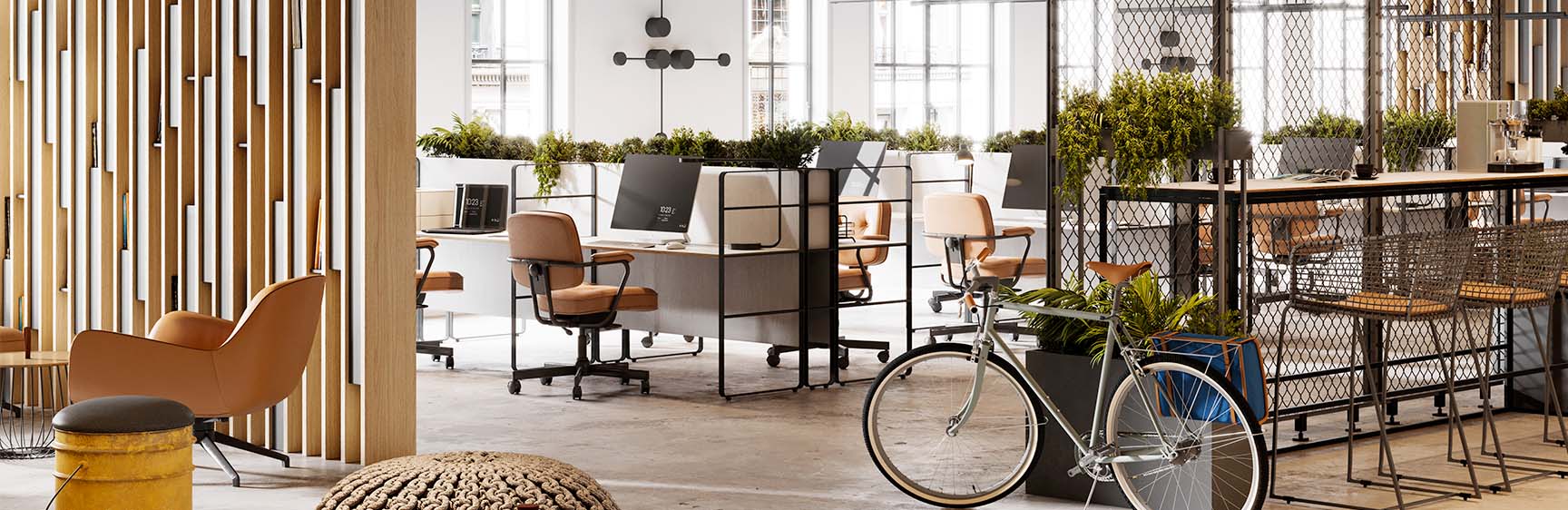
- A relaxation area to recharge your batteries and relieve the pressure. For example, opt for low, restful furniture (footstools, armchairs, coffee tables, sofas), use bright, lively colors, and create a playful corner (games, music, a space for personal creation...).
- A quiet zone for working in peace and quiet. In this area, cell phone ringing and telephone conversations are prohibited. To create an atmosphere of reflection and concentration, separate each desk with small partitions.
- A space dedicated to collaboration and discussion to optimize collaborative work. This brainstorming area needs to be ultra-connected and feature a writing board. You'll also want to choose scalable tables, so you can easily change the configuration of the meeting space to suit the needs of the organizer and participants.
- Individualized, soundproof booths are reserved for telephone conversations.
The objective? Alternate between rest periods, isolated work and teamwork.