
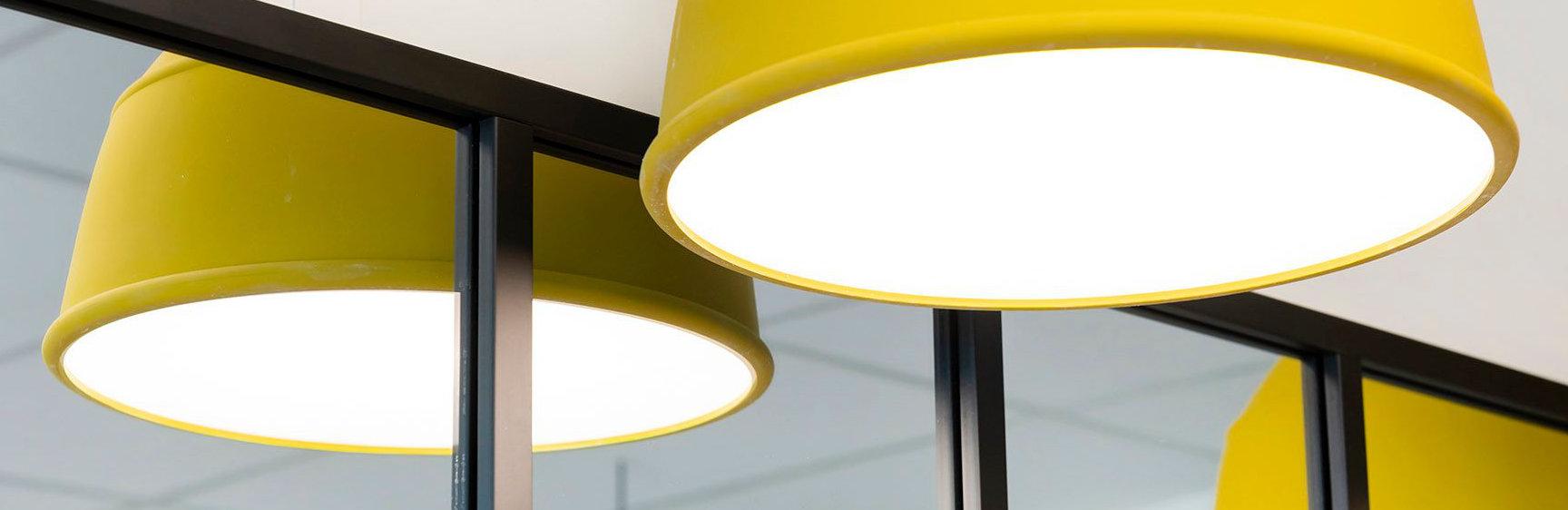
Les lumières dans un espace de travail représentent un véritable atout pour stimuler vos collaborateurs. Essentiel pour protéger la santé oculaire et favoriser la concentration, l’éclairage des espaces de travail est également très encadré par la loi. Pas de place à l’improvisation pour assurer la meilleure luminosité possible dans l’aménagement de vos bureaux.
Une bonne luminosité a un impact sur l’efficacité des collaborateurs
La lumière naturelle joue un rôle déterminant sur le fonctionnement de l’horloge biologique interne. En cas de carence, le cerveau ne sécrète plus assez d’hormones favorisant l’activité physique et cérébrale.
Dans un bureau sombre, les salariés se fatiguent ainsi plus rapidement et rencontrent plus de difficultés à se concentrer.
Un manque de luminosité, ou au contraire un sur-éclairage, est source de fatigue oculaire, de maux de tête, d’irritabilité et de mauvaises postures.
L’éclairement minimal recommandé pour bien travailler est de 200 à 800 lux en fonction de l’activité exercée.
Agencement de bureau, clé de la gestion de la luminosité
Pour une meilleure luminosité, commencez par optimiser l’agencement de l’espace de travail. Privilégiez avant tout la lumière naturelle. Dans cette optique, placez les bureaux le plus près des fenêtres et les écrans d’ordinateurs perpendiculairement à celles-ci.
Combinez éclairage direct et indirect. Pour être optimal, le rapport entre l’endroit le plus sombre et l’endroit le plus lumineux de la pièce doit être compris au maximum entre 1 et 5.
N’hésitez pas également à ajouter des miroirs, qui sont des réflecteurs naturels de lumière et qui vous permettront d’augmenter facilement la luminosité de votre espace, et peignez vos murs dans une teinte claire.
Enfin, n’oubliez pas que l’installation de stores est primordiale pour gérer les flux de lumières. Trop de lumière peut par exemple éblouir en été et gêner vos collaborateurs dans leur travail. Le fait de les fermer complètement ne laisse pas la possibilité d’entrevoir la lumière du jour, source de bien-être. Il s’agit donc de trouver un entre-deux.
Outre le choix des lumières, la teinte de la couleur des murs est également un critère de choix. Pour favoriser la concentration de vos collaborateurs, optez par exemple pour une teinte gris clair ou beige. Pour stimuler la créativité, la couleur jaune, positive et lumineuse, est adéquate, et reflétera à merveille la luminosité naturelle.
Meilleure luminosité au bureau : quel système d’éclairage choisir ?
Si la lumière naturelle est à privilégier, elle ne peut bien entendu assurer en continu confort visuel et uniformité d’éclairage. Il est donc essentiel de multiplier les sources d’éclairage artificiel. Pensez à éviter l’éclairage direct.
L’éclairage général de la pièce issu du plafond devra être compris entre 3 500 et 4 000 Kelvins. Quant à l’éclairage individuel, la médecine du travail recommande, pour un éclairage ergonomique, l’usage de lampes de bureau émettant entre 2 700 et 3 000 kelvins.
Types, couleurs, puissance… Le choix des ampoules n’est pas non plus anodin. Pour un travail sur écran, optez par exemple pour un éclairage chaud naturel et pas trop blanc. Dans cette optique, une ampoule de 15 watts est largement suffisante. Conçu pour s’adapter à l’horloge biologique de l’être humain, l’éclairage biodynamique peut être un excellent remède. Le matin par exemple, l’individu a moins besoin de lumière. Un lampadaire biodynamique va donc produire une lumière froide et moins vive, qui va, au fil de la journée, devenir de plus en plus chaude.
Attention : l’éclairage en entreprise est soumis à des normes précises. Le code du travail et les décrets d’application N° 83-721 et N° 83-722 du 2 août 1983 posent ainsi les bases légales de l’éclairage des lieux de travail : « L’éclairage doit être conçu et réalisé de manière à éviter la fatigue visuelle, ainsi que les affections de la vue qui en résultent, et permettre de déceler les risques perceptibles à la vue. Les locaux de travail doivent autant que possible disposer d’une lumière naturelle suffisante »
L’AFE (Association française de l’éclairage) recommande un éclairage moyen de 300 lux pour une activité du bureau, de 500 lux pour une activité de traitement de données ou de dactylographie et pour l’éclairage d’une salle de conférence.
Les normes françaises NF X-35-103 et NF EN 12464-1 sont également à prendre en compte dans l’éclairage des espaces de travail.
Une fois toutes ces caractéristiques prises en compte pour gérer l’éclairage dans vos espaces de travail, il s’agira d’optimiser la décoration des bureaux, pour favoriser à la fois une bonne luminosité, et un confort généré par le mobilier. Ces éléments favorisent la qualité de vie au travail.