
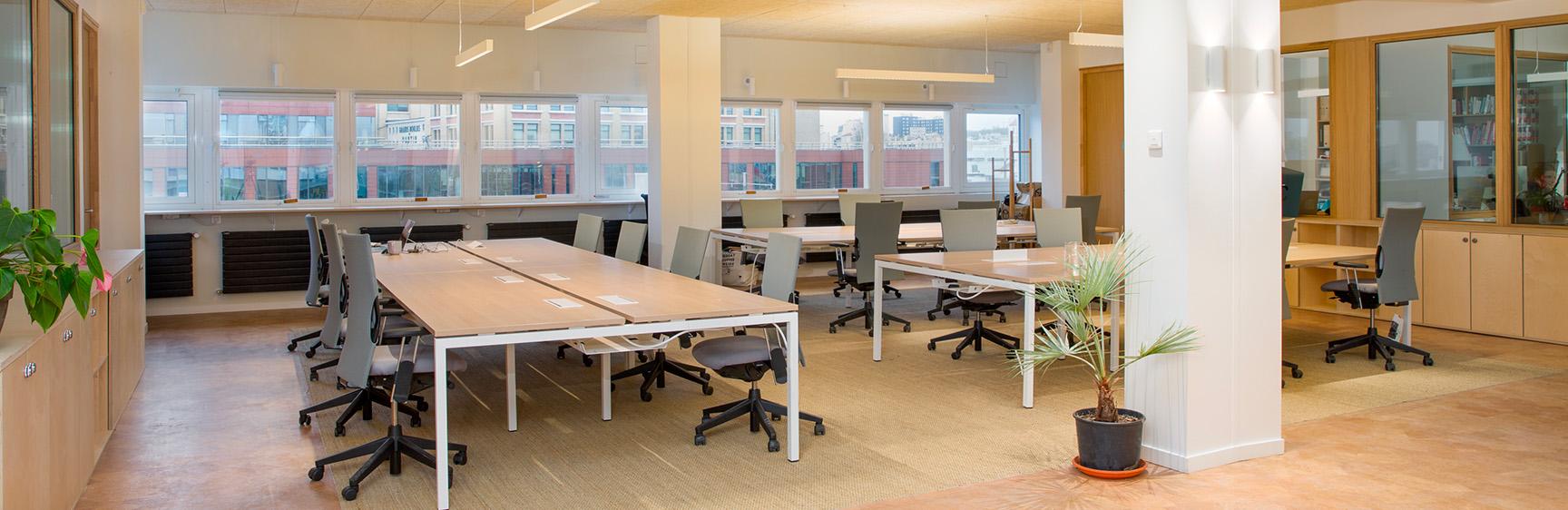
Driven by European directives and the 2015 Paris Agreement, eco-design is gaining increasing ground within companies. This new trend is also encouraging them to integrate an environmental and sustainable approach into their office layouts, by favoring bio-sourced materials. Here's how.
Office design: everything you need to know about bio-sourcing
Bio-sourcing is the use of bio-based materials as raw or even primary materials in the manufacture of products or materials.
It's an alternative to artificial, polluting materials, thanks to the use of biotechnologies. In this process, fossil fuels are replaced by plants.
The materials used come from biomass of animal or plant origin: wood, cork, straw, hemp, cellulose wadding, linen, recycled textiles, chenevotte and sheep's wool.
The aim? The use of bio-sourced materials in construction enables atmospheric carbon to be stored, and natural resources to be used sparingly.
The guarantee of a bio-sourced product is not limited to a label. A number of parameters need to be taken into account to ensure a genuine biosourcing approach:
- Transport: its environmental impact must be limited. To achieve this, travel time must be reduced as much as possible in order to respect the carbon footprint ;
- Composition : it's important to ensure that the entire manufacturing chain is 100% natural, with no additives, in order to offer the most virtuous material. The materials used must not contain toxic solvents, varnishes or glues, so as not to release VOCs (Volatile Organic Compounds) that are harmful to health over time.
- The ecological origin must therefore be perfectly defined and its impact on environmental protection verified.
This environmental performance can be guaranteed if the product meets the requirements of the C2C - Cradle to Cradle - ecolabel, which validates the eco-design approach on the basis of 5 criteria: sound materials, reuse of materials, renewable energies and carbon management, water management and social equity. A technical committee mandated by the European Union, CEN/TC 411, is also responsible for defining standards for bio-sourced products.
As well as being good for the environment, the use of bio-sourced materials in office design has an impact on the health and well-being of its occupants: improved indoor air quality, luminosity, humidity regulation, acoustic and thermal comfort. The eco-responsible approach to designing a working environment therefore has many advantages.
How to create an eco-responsible workspace using bio-sourcing?
Insulation, mortars, concretes, paints, floor coverings, coatings, resins, woodstains, glues, partitions, ceilings, acoustic panels - today there are bio-sourced materials for every phase of construction.
The layout of the workspace must also be part of this eco-responsible approach: selection of ecological and recycled office furniture with the smallest possible overall ecological footprint, creation of natural ventilation, greening of the workspace, installation of shared waste sorting garbage cans, use of energy-saving electrical equipment, natural lighting... Even supplies and consumables are no exception!
By providing employees with a healthy environment and a serene atmosphere, sustainable office real estate is part of the company's CSR approach.
Thanks to his expert eye and in-depth knowledge of the various labels, the architect will be able to guide you in your choice of bio-sourced materials and eco-responsible products. He has been aware of environmental issues for several years, and constantly monitors suppliers to ensure that his customers benefit from the most eco-friendly products.
Biosourcing and coworking offices: the successful example of Oasis 21
Open since January 2021 in the Halle aux cuirs de la Villette, Oasis21 is a third-party space dedicated to organizations involved in the ecological and civic transition. The concept? 1,500 m2 of fully refurbished space combining eco-construction, reuse and energy sobriety. Interview with Philippe Iglesias, head of construction and civil engineering projects at KRE Concept, the design office responsible for this large-scale office development project.
What is Oasis21?
The Oasis21 project was born in 2017 within the Colibris association, which wished to create a third place adapted to the specific needs of actors in the ecological and citizen transition in Paris. This large coworking space, combining bright, enclosed medium-sized offices and nomadic offices, was designed with a commitment to eco-built architecture favoring reuse, natural materials, local sourcing and manufacturing, and energy savings.
What role did KRE Concept play in the project?
We were initially consulted as recognized experts on issues of high environmental value, and then retained by the client and architect as the general contractor to carry out the work and source natural materials from France and Europe. Not only were we the most competitive, we were also able to commit to deadlines. The project began with a month and a half of cleaning work, followed by five months of interior outfitting.
How did you select the materials used?
We responded to the customer's request to use only bio-sourced materials. We sought to source materials that were as environmentally friendly as possible. With this in mind, we sourced the production and supply chains, and the constitution of the materials, while favoring short circuits. We also relied on recognized biosourcing labels, such as Cradle to Cradle, and chose only 100% natural materials: cork flooring, seaweed paint, wood, sisal, biofiber insulation...
How do you see the future of the circular economy?
In the construction industry, this economy is both recent and inescapable. Although there's still a long way to go in this area, the world of building and the major players in the construction industry are increasingly aware of the importance of reducing consumption, reusing materials and recycling waste.